Sunday, 29 March 2009

Intercambios


Making Spanish friends tops the list of things to do for many students who choose to study abroad. This has proved to be challenging at times but is well worth the effort. My Spanish has improved more in the last two months by talking with Spaniards than in the last six years of taking Spanish class in high school and college. The only real way to get better at speaking is to put your self into Spanish speaking situations on a daily basis.

The first thing I would recommend to a student trying to meet Spaniards is to sign up for an intercambio. Actually, you don't even need to sign up for one because UPO automatically pairs you up with one at orientation. Essentially, an intercambio is a Spanish speaking partner in which you spend a half hour talking in Spanish, and the other half talking in English. For the most part, the intercambios are translation majors at UPO and are very patient because they struggle with the exact same difficulties in class every day. Sometimes you will be assigned an intercambio who you don't really feel compatible with or one who doesn't respond to your e-mails. In this case, simply ask for a new one and keep trying until you find someone you enjoy spending time with. In addition, UPO usually has a Spanish-speaking table once a week where you can meet up with Spanish students and practice your speaking. Take advantage of this because it's a great way to meet people not to mention they have free tapas and soft drinks.

The next thing I would recommend is to simply not be shy and ask people for their phone numbers. Just yesterday I was renting a Sevici bike and a Spaniard girl behind me struck up a conversation with me in English. Turns out she was looking for an intercambio too and we exchanged numbers to meet up later for coffee. Numerous times my roommates and I have found ourselves in similar situations and nearly everyone is just as excited to learn our language as we are to learn theirs. So don't be shy and if you meet someone at school, in a restaurant, cafe, bar, etc. don't be afraid to ask to meet up again.

Another recommendation I have is to sign up for Tuenti (www.tuenti.com). This is essentially the Spanish Facebook although many Spaniards I have met have both. It is a very easy way to better get to know someone you have meet and to coordinate a time and place to meet. Spanish students are just as obsessed with Tuenti as American students are with Facebok.

All in all, it may take a while to create a network of friends for yourself in Spain, but don't give up. It took me nearly the first month and a half to finally make Spanish friends and get comfortable enough to have a conversation with someone in Spanish.

Friday, 13 March 2009

Movies and Books in Spanish

I recently went to see a movie here in Sevilla and walked away with more than I expected. I was not quite brave enough to try watching a movie in Spanish so I went to the movie theater called Cine Cinco that plays movies in their original language with Spanish subtitles. It turned out to be more of a learning experience than I thought. As I watched the film I kept my eye on the subtitles and actually picked up a lot of new vocabulary words. The best part about it was that I learned so many new slang words and phrases that are sometimes hard to come by in a classroom setting or hard to decipher in a conversation. I´ve found that I learn best when I´m able to see things written out. Everyone has a little different learning style but this has been what has worked best for me. Additionally, you can set the subtitles to Spanish on your DVDs that you´ve brought from home when you´re looking for something to do during siesta or on a rainy day.

Another good way to pick up the language is by reading books in Spanish. If you´re anything like me and are not quite ready to dive into a challenging book written completely in Spanish, I have a good recommendation. I´ve found books that are written on one side of the page in English and the other side in Spanish. This way you can read in Spanish until you come across a word or phrase that you don´t understand and then simply glance across to page to find the meaning. I´ve found that this is much less tedious than reading a book with a translation dictionary in hand. Thus far, the only place I´ve been able to find these books is at a bookstore in El Centro called Casa de Libros in the English literature section. On the map below, I´ve attached a Google map of the locations of both Casa de Libros and Cine Cinco.


View Cines Cinco and Casa de Libros in a larger map

Thursday, 12 March 2009

Cordoba


If you're looking for a little supplement to your Spanish history class then a quick day trip to Cordoba might be just what you're looking for. In the 8th century, Moorish rules conquered Cordoba and made it the Islam capital in the Iberian Peninsula. Later, Abd ar-Rahman I declared himself ruler of the Moorish Iberian Peninsula. The town is rich in history and is extremely interesting to see in person the things you talk about in class.

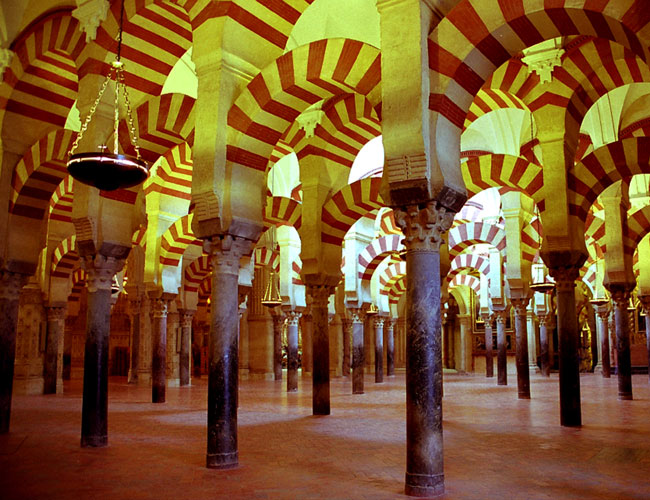
Cordoba is home of the Mesquita, known in most history books as The Great Mosque of Cordoba. The Mesquita was founded in the 8th century and construction began on the old site of a Christian church. In the 10th century, the rulers of the Moorish Iberian Peninsula began making lavish additions to the cathedral which gave the Mosque 23,000 square meters of space and 1293 Moorish arches painted in red and white. Most of the original Moorish architecture remains, however with one addition: a 16th century cathedral added right in the middle of the mosque. As the Christians began taking over Spain and kicking out the Muslims, one of the most powerful ways of showing the superiority of religion was to tear down the mosques and put a cathedral in its place. As a result, the Mesquita is a very interesting piece of architecture as it contains elements of 10 century Moorish architecture as well as elements of a 16th century cathedral. This mosque alone is worth the trip to Cordoba. Don't forget your camera because this Mosque/Cathedral is one of the most picturesque sites in all of Andalucia.

Another great site to see in Cordoba is the Alcazar de los Reyes Christianos (Castle of the Christian Monarchs). At about the same time the cathedral was added to the Mesquita, this castle was built to as a palace and fort for the Christian monarchs. During the Inquisition, this castle was also used as a center for operations. Today it is one of the most beautiful palaces in Andalucia with its gardens, ponds, orange tree patios, and fountains. Nearby is the Roman Bridge which crosses the Guadalquivir river.

If you are interested at all in the literature of Miguel de Cervantes, then you may want to wander to the Posada del Porto. This was the inn where Cervantes resided while writing Don Quixote. In fact, the "den of thieves" in the book was based off this location. It is nothing too spectacular to see but if you've read Don Quixote it may be worth a stop by.

The rest of your time can simply be spent walking around the Jewish Quarter. This medieval neighborhood has narrow winding streets and whitewashed houses. This area makes for some good wandering and a good place to get lost for an hour or two.

Getting to Cordoba from Sevilla is very easy. If you're willing to fork over 40 Euro round trip, then you can ride the high speed AVE train and arrive in Cordoba in about 45 minutes. However, if you're looking for a more student-friendly trip, then the regular train and bus cost around 14 Euro round trip and last 1.5 and 2 hours respectively. Trains and buses run regularly all day so you should have no trouble finding one to fit your schedule.


Sunday, 8 March 2009

Texting in Spanish


In one of the Spanish classes here in Sevilla, we recieved some very helpful information about text message slang in Spain. Spaniards tend to use a lot of short cuts when texting and they can at times be impossible to decipher. Here is a list of codes that you can use to decode a text message you may recieve from someone in Spain.

a2 = adios
1b = un beso
h lgo = hasta luego
ns00 = nos vemos
salu2 = saludos
Xfa = por favor
qtl = ¿que tal?
rll = rollo
skndalo = escandalo
fnmnl = fenomenal
find = fin de semana
hr = hora
ymam = llamame
k hcs? = ¿que haces?
qdr = quedar
slmos = ¿salimos?
tspro = te espero
vaks = vacaciones
qndo? = ¿cuando?
dnd? = ¿donde?
nd = nada
nk = nunca
xa = para
x = por
xq = por que
qn = quien
tb = tambien
t2 = todos
krño = cariño
klg = colega
dsr = desear
br = bar
kf = cafe
+trd = mas tarde
mñn = mañana
nch = noche
zzz = cansado
grr = enfadado
s3 = estres
frt = fuerte
ntnfds = no te enfades
pso = paso
sntr = sentir
t echo de = te echo de menos
tq = te quiero
ygo trd = llego tarde
nph = no puedo hablar
q vrt = quiero verte
nryrse = enrollarse
1bszo = un besazo
crvz = cerveza
kch = coche
dskotk = discoteca
d = de
sty = estoy
stamos = estamos
+ = mas
- = menos
q = que
tmr = tomar

Friday, 6 March 2009

Where to watch soccer in Sevilla

Keeping up with what is going on the the Spanish Premier league is a great way to find common ground when talking with Spaniards. Having a basic knowledge of soccer in Sevilla and in Spain in general is extremely beneficial when trying to make friends. Many times you may find yourself trying to think of different points of conversation. Talking about "futbol" is definitely a popular topic among most Spaniards.

The first place I would recommend watching a soccer game is live at stadium of one of the two professional teams in Sevilla. The two teams in Sevilla are Real Betis and Sevilla FC. I have had luck getting tickets to a Sevilla FC game by simply going to the ticket office at the stadium a few days before the game. If the game is a highly anticipated game, the tickets will likely be more expensive and I would recommend getting to the ticket office farther in advance. You can usually find tickets for around 30 euro. My experience was incredible and I would highly recommend attending a game possible because it is unlike any sporting event in the United States.
Link
If you can't make it to the game, there are still plenty of places to watch on TV. If you don't have access to a TV in your home stay then you may find yourself looking for a sports bar to watch the game. I have created a Google Map (click here) with my favorite places to watch along with a little commentary as to what to expect at each location.

View Larger Map

Thursday, 5 March 2009

Soccer Vocabulary

One thing I've found to be really helpful in sparking conversations with Spaniards is knowledge of Spanish soccer. The people of Spain are die-hard soccer fans making this topic a great conversation starter. I've found a pretty comprehensive list of vocabulary that has helped me in making Spanish friends. In fact, my Spanish speaking parter recently took me to a Real Betis match with her family where I made use of many of these terms. It was an incredible experience that would recommend to anyone visiting Spain.

The Field
  • el campo; la cancha; el terreno de juego = the field, the pitch
  • la mitad de la cancha; el medio de la cancha = the middle/half of the field
  • el area = the penalty box
  • linea de banda = sideline; touchline
  • linea de fondo? = endline; goal-line
  • punto penal = penalty spot
  • manchpunto derecho = right corner flag
  • punto surdo, izquierdo = left corner flag

The Teams
  • la seleccion = usually a national team
  • equipo; conjunto = team
  • equipo visitante = visiting team
  • equipo local = home team
  • las alineaciones; el plantel = the lineups; the roster
  • director tecnico; D.T. = the coach

The Players
  • jugador = player
  • defensor = defender
  • mediocampista = midfielder
  • laterales = wingers
  • arquero; conservero; guardameta; portero = goalkeeper
  • volante; atacante; delantero = forward; striker
  • hombre de punta = usually a lone striker; any forward
  • goleador = a goal scorer, one who scores very often
  • maximo goleador = leading goalscorer
  • hombres de relevo = reserve players
  • lesionado = injured
  • paisano; coterraneo = countryman

The Fans
  • la asistencia = the attendance
  • el publico; los aficionados = the fans
  • tacones; tacos = soccer shoes/cleats/boots
  • pie = foot
  • la barra brava; los fanaticos = the dedicated fans
  • la barra; la tribuna; la hinchada = same as above

Rules and Standings
  • el marcador = the score
  • el comienzo; arranque = the beginning, the start (of the season,of the game,etc)
  • primer tiempo/periodo = first half
  • segundo tiempo = second half
  • tiempo reglamentario = regulation time
  • el arbitro = the referee
  • juez de linea = linesman; line judge; referee’s assistant
  • substitucion = to leave the field (as in substitution)
  • entrar = to enter the field (as in substitution)
  • la temporada; el torneo; el campionato = the season
  • la ligilla; los play-offs = the playoffs
  • la revancha = the second leg in a two-game series or revenge, as in the second time that two teams meet
  • invicto = undefeated
  • carton amarillo; tarjeta amarilla = yellow card
  • carton rojo; targeta roja = red card
  • expulsion = ejection
  • hacer tiempo = to waste time (intentionally)
  • tactico = tactics; strategy
  • abilidoso; muy abil = technical ball skill

Technical Terms
  • la/una jugada; maniobra = the/a play; “handiwork”
  • jugadas de pelota parada = set plays
  • cruce; centro = cross; center (e.g. into the penalty area)
  • lateral; saque lateral; saque de banda = throw in
  • tiro de meta; saque de meta = goalkick
  • tiro de esquina; corner = corner kick
  • fuera de juego; posicion adelantada; offside = offside
  • tiro libre = free kick
  • infraccion = infraction
  • tiro penal; penalty = penalty kick
  • la banca = the bench
  • el cambio = the substitution
  • calentando = warming up (reserve players)
  • en casa = at home
  • visitante = on the road
  • de primera (intencion) = first-time; one-time
  • de chilena = bicycle kick; overhead volley
  • en palomita = diving header
  • de taco = backheel pass
  • remate; disparo = shot at goal
  • completamente desviado = a shot way off the mark
  • bombazo; canonazo; bazookazo = a REALLY hard shot at goal, usually from long distance
  • defenir = to finish (an opportunity)
  • marcar; denotar = to score a goal
  • empatar = to tie/draw
  • cabezazo; golpe de cabeza = header
  • codazo = elbow foul
  • hombrazo = shoulder foul
  • mano = handball
  • abrir la cancha = to open the field (i.e. spread it out to the wings)
  • cambio de frente = a switch of play to the opposite side of the field
  • contragolpe = counterattack
  • al medio; por la mitad = to/through the middle
  • la barrera = the defensive wall during a free kick
  • pase = pass
  • en corto = very short passing; early cross?
  • devolution = return pass
  • despeje = defensive clearance

Describing the Run of Play
  • No hay tiempo para mas! = There’s no time for any more! (end of first half, regulation time, overtime, etc.)
  • Viene, viene, viene! = Here it comes! It’s coming! (a goal)
  • Esta! = “It’s (almost) here!” (a goal)
  • No vale! No vale! = It doesn’t count! (disallowed goal, or when play proceeds a little after the offside call, etc.)
  • Paso Wynalda! = “Wynalda broke through!” en el piso = on the ground (as in keeping the ball low; or as in reference to a fallen player; etc.)
  • de punta y para arriba = of a ball hit long and high (said with a negative tone…)
  • lento = slow
  • totalmente desviado = totally off the mark (a shot at goal)
  • afuera = outside (refers to shots that go wide)
  • arriba = up (refers to shots over the crossbar)
  • buscando el empate = looking for the tie, or striving for the tying goal
  • lo perdise equivoco = he messed up
  • bien = good
  • mal = bad
  • de larga distancia; desde lejos = from long distance
  • correr = to run
  • pedir = to ask for (e.g. the ball)
  • cuidar la pelota = to maintain possession of the ball (by a player or team)
  • recuperar = to regain (the ball)
  • Peligro! = danger! (as during a threat at goal)
  • dejarla/lo = to leave it (the ball) for another player to run onto
  • Lo pego! = he hit it! (at goal)
  • presion = pressure (defensive or offensive)
  • salida = a play bringing the ball out of one’s defensive half
  • desde el fondo = from the back (as in an attack generated by the defense)
  • ganar = to win
  • perder = to lose
  • …que favorese = …”in favor of; for; belonging to (El tiro libre que favorese al Clash… = The free kick for the Clash…)
  • pelear; luchar = to fight (for the ball, for the win, with each other, etc.)