If you're looking for a little supplement to your Spanish history class then a quick day trip to Cordoba might be just what you're looking for. In the 8th century, Moorish rules conquered Cordoba and made it the Islam capital in the Iberian Peninsula. Later, Abd ar-Rahman I declared himself ruler of the Moorish Iberian Peninsula. The town is rich in history and is extremely interesting to see in person the things you talk about in class.
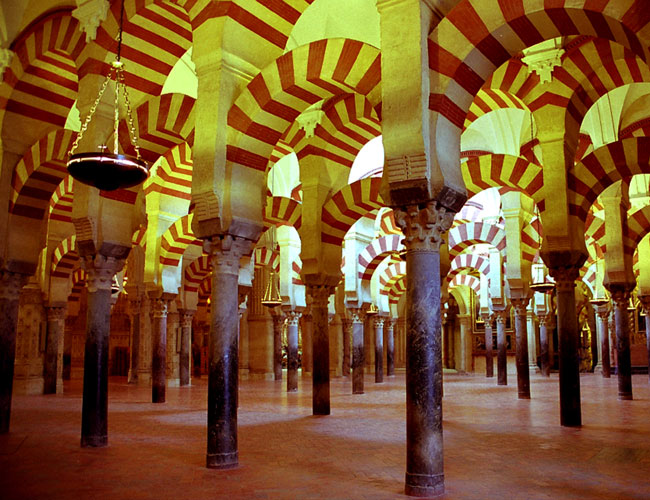
Cordoba is home of the Mesquita, known in most history books as The Great Mosque of Cordoba. The Mesquita was founded in the 8th century and construction began on the old site of a Christian church. In the 10th century, the rulers of the Moorish Iberian Peninsula began making lavish additions to the cathedral which gave the Mosque 23,000 square meters of space and 1293 Moorish arches painted in red and white. Most of the original Moorish architecture remains, however with one addition: a 16th century cathedral added right in the middle of the mosque. As the Christians began taking over Spain and kicking out the Muslims, one of the most powerful ways of showing the superiority of religion was to tear down the mosques and put a cathedral in its place. As a result, the Mesquita is a very interesting piece of architecture as it contains elements of 10 century Moorish architecture as well as elements of a 16th century cathedral. This mosque alone is worth the trip to Cordoba. Don't forget your camera because this Mosque/Cathedral is one of the most picturesque sites in all of Andalucia.
Another great site to see in Cordoba is the Alcazar de los Reyes Christianos (Castle of the Christian Monarchs). At about the same time the cathedral was added to the Mesquita, this castle was built to as a palace and fort for the Christian monarchs. During the Inquisition, this castle was also used as a center for operations. Today it is one of the most beautiful palaces in Andalucia with its gardens, ponds, orange tree patios, and fountains. Nearby is the Roman Bridge which crosses the Guadalquivir river.
If you are interested at all in the literature of Miguel de Cervantes, then you may want to wander to the Posada del Porto. This was the inn where Cervantes resided while writing Don Quixote. In fact, the "den of thieves" in the book was based off this location. It is nothing too spectacular to see but if you've read Don Quixote it may be worth a stop by.
The rest of your time can simply be spent walking around the Jewish Quarter. This medieval neighborhood has narrow winding streets and whitewashed houses. This area makes for some good wandering and a good place to get lost for an hour or two.
Getting to Cordoba from Sevilla is very easy. If you're willing to fork over 40 Euro round trip, then you can ride the high speed AVE train and arrive in Cordoba in about 45 minutes. However, if you're looking for a more student-friendly trip, then the regular train and bus cost around 14 Euro round trip and last 1.5 and 2 hours respectively. Trains and buses run regularly all day so you should have no trouble finding one to fit your schedule.

No comments:
Post a Comment